Showing posts with label Deconstruction. Show all posts

Wednesday, December 21, 2011

Bandolier?

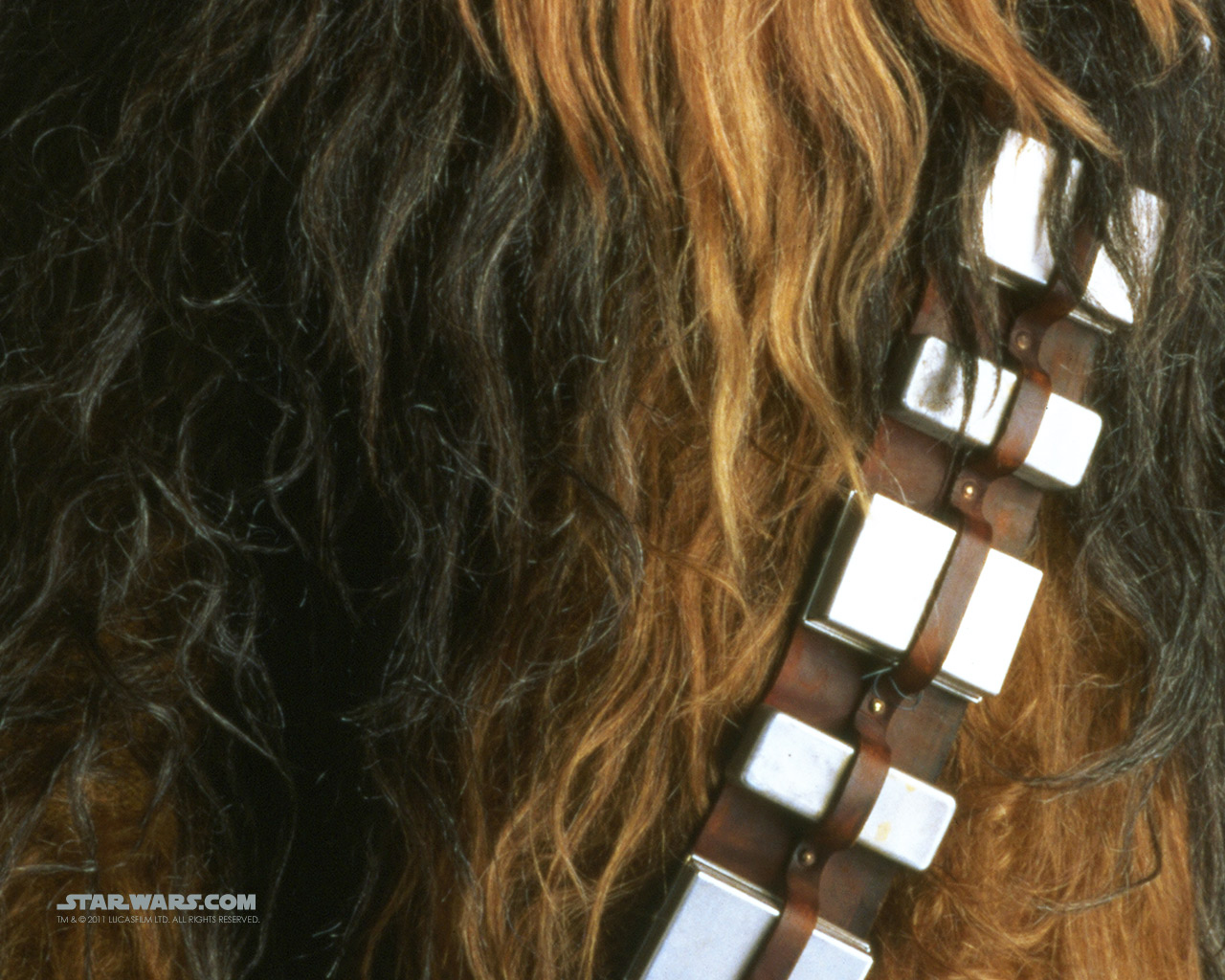
So, since I'm busy quibbling about continuity in movies, something came to me while watching "The Empire Strikes Back" after seeing it for the umpteenth time -- in the torture scene(s), when Chewbacca is in the cell, being subject to sonic torture, did you notice that he's wearing his ammo bandolier?


Now, these are, we are to believe, power packs for his famed "laser crossbow," whatever that is, exactly. Some kind of glorified blaster. At any rate, it's an effective weapon he'd put to good use a time or two.

But the Imperials just chucked Chewie into the torture room with his bandolier. Huh. Given the Wookie's propensity for tech prowess, I have to wonder what they were thinking with that. Now, maybe it was a part of the costume and Lucas didn't want to have to redesign it or whatever. But, strictly speaking, from a continuity perspective, the presence of that bandolier is troubling -- there are likely any number of things a knowledgeable soul could do with blaster ammo clips/power packs, yes? We see him put C-3P0 together without much more than a hydrospanner, so surely he could do a lot of damage with a bandolier full of power packs.

Continuity. Are we to believe the Imperials are so contemptuous of the Wookie that they'd let him go into a jail cell packing his ammo like that? Especially when they are careful to cuff Chewie later, showing that they are clearly aware of the Wookie danger.

Just something I noticed. Maybe not as egregious as Leia rolling over for Jabba, but still a troubling bit of discontinuity in the movie. Lucas obviously didn't think of anything like that for Chewie, since he was only a secondary character, and wasn't going to have the enterprising Wookie bust himself out of dodge with some adroit use of the ammo clips he was packing; still, it would have been nice for Lucas to have given Chewie the benefit of a doubt and showed him without his bandolier, just to reflect the thoroughness of the Empire's detention policies.

Side note: It's kind of ironic, isn't it, those torture scenes? I mean, when that movie came out, what was it, in 1980? Torture was seen as synonymous with Imperial evil (which, of course, it is, yes?) But now, watching even those sanitized, PG-rated torture scenes, it's sort of creepy to think that torture is now officially part of American policy (as is indefinite detention and rendition of prisoners, including Americans). What used to be a cartoonish stand-in for the villainy of the Empire (Leia getting interrogated in "Star Wars" by the creepy Imperial Torture Droid; Han, Chewie and Leia getting tortured on Bespin) is now our government's policy. How times have changed! The outrages of 1980 are the official policies of 2011.

*cue "The Imperial March" as new national anthem*

Thursday, August 19, 2010

Dinobotics

Okay, I'm probably asking for it by even analyzing it, but why the hell are the Dinobots stupid?

I never liked the Dinobots, and watching the show with my boys, I am reminded of how annoyed I was at the Dinobots all over again. They're robots. Thinking machines, crafted by Wheeljack, the prime inventor/engineer of the Autobots, who seems tirelessly talented in creating things. And he designed the Dinobots with the help of Ratchet (I think), emphasizing the strength and power of the dinosaurs in their design, and, apparently, their lack of brains. Alright, so while it might play well as a wrinkle in the plotline to have these dumbass robots in their midst, and it's certainly played to amusing effect in the storyline, such as it is, but the logic's just not there -- a slow-witted robot? Sentient enough to have a sense of self and identity and to carry out its functions, but otherwise not sharp? Makes no sense.

Ratchet and Wheeljack could've simply designed them to have strong chassis and have them have the CPUs able to handle that kind of load and power -- if anything, their strength, size, and power would make it vital for them to have a reasonable amount of intelligence. Prime, in greenlighting the creation of the Dino-dullards, makes a grievous error in judgment, unleashing these dangerous machines on the world.

Of course, the implications of the Dinobots aren't fully explored -- it's a kids' show, after all -- but stupid robots? Huh? Since robots are designed with a purpose in mind, the abdication of good sense on the part of the creators of the Dinobots is kinda shocking, given that the Autobots made them, the ostensible good guys of the series. It would be like equipping a main battle tank with the brain of a dog to guide it. Not a good plan.

This clip somebody made (and amusingly edited to show how thick they are) highlights the central flaws of the Dinobots... ("Do you understand?" The second part of this clip is similarly amusing)...

Story of the Dinobots

Friday, February 5, 2010

Salacious Salinger?

I think the absence of sex in Salinger's work was because he was a pedophile.

http://www.slate.com/id/2243564


Something about the character of Seymour always made me think that, although it's been so long since I read any of Salinger's work, I can't fully recall, and am perhaps too lazy to go back and lay it all out, but at the time, I remember reading him and thinking "Huh. WTF?" I think Seymour was a projection of Salinger himself, more than even most characters are with writers, and I think that might account for why Salinger was so reclusive and paranoiac, and why the only interview he granted was to those high school students in the early 70s. I think Salinger liked kids. Maybe REALLY liked'em. His estate is surely keen to control the legacy of his work (whatever that precisely is), so, like Jacko, it'll be something that's camouflaged, explained away, and/or concealed. But still, it makes me wonder.

Monday, December 7, 2009

Movies: The Matrix -- Bum Watching

Funny how "The Matrix" -- which was so influential for a little while, in terms of style, how, I dunno, dated it is, too. I enjoy it more now than I originally did. I actually found it very disappointing when I saw it on the big screen. Trinity reminded me of Abby Normal, a character I'd made at least a decade before (herself my own kind of take on Molly from "Neuromancer" -- a recurring character William Gibson used in a few tales). At any rate, "The Matrix" blew its wad after the first movie, staggered, stumbled, fell.

One thing that amused me with it, however, something that was never really dealt with in the pseudo-scientific spackle that made up the story was the Matrix itself. One image in particular (and a minor one at that) always stuck with me -- it was near the end, when a bum in the subway sees Trinity and Neo do something extraordinary, and that alerts Agent Smith, who appears in a few moments to attack Neo. Well and good.

But the bum in the subway always amused me -- Smith talks about how suffering and strife appeared to define humanity's existence, and how perfect Matrices led to the loss of "whole crops" (as he termed humanity). So, the concept of struggle was introduced, and the Matrix ideal archetype was set, with late 20th century civilization set up as civilization at its peak.

So, there's the bum in the subway, and I always found myself wondering: who gets to be the bum? Who's the lucky soul who is the Designated Bum in the Matrix world? For much of the movie, you see this very clean corporate world -- lots of movers and shakers, a few working-class types, some shadowy cops, even some rain-slicked streets and derelict buildings.

But who gets to be the bum? How does that work out? In this world, a variety of situations can lead to that, sure -- mental illness, terrible sustained misfortune (?) -- both? It takes something pretty bad for somebody to end up a bum. However, in a created universe, one that is administered as the Matrix is, something (the Architect, I guess?) is deciding who does what. I guess the program decides that X% of the populace gets to be bums, Y% gets to be famous and rich, Z% occupies some middle niche.

In the movie, you see Cipher talk to Smith about what he wants to be, when he gets plugged back in, and so you can see that there, at least in theory, is some process of allocation in the Matrix, at least for those who are aware of it as a construct.

That being said, say you are one of the unlucky sods who ges to be The Bum. Since the system is a program, since your Bum archetype is effectively your programming, is it possible for you to rise above your "station" -- to become more than a bum, more than a derelict? Or is that guy resigned to his condition, drinking rotten booze and laying there in a subway with his newspapers and his filth because he's lacked the willpower to move beyond his programming.

Given the ghetto Nietzschean values that underpin so much of "The Matrix," it's very hard to look at the Bum and not think that this guy is just a complete human waste, and if he only had the Will To Power(tm), he'd be a player like Neo and Morpheus and the other Matrix Kool Kids(tm).

All the same, I find it funny to think of these constructs with their apparent lot in life, just because it's one thing to have a construct of a playboy club kid, or a restauraunteur, or a tycoon, or fashion model or a rock star -- but the bum? How much does that suck? Big-time. So, is that an expression of the inhuman cruelty of the Matrix in action, or does the Bum(tm) serve a purpose within the Matrix itself, as a cattle prod to ensure that the constructs within it are all busy working hard so they don't, themselves, end up as bums? Since nothing in the Matrix is truly accidental (since it is a program, we have to assume this, right?) -- then the Bum exists for a reason.

Still, I can't help but laugh every time I see that hapless bastard in the subway -- it's somehow an extra screw-job to be a bum in a virtual universe. Bad enough to be one in the real world, and somehow an extra kick in the teeth to be one in a virtual world.

Tuesday, December 1, 2009

Are We Not Males?

The title of this book makes my mental wheels turn a bit...


It achieves a slightly transgressive flavor, but it castrates itself a little with "Males." That single word fatally undermines the title, by weakening the impact of the overall phrase. "Males?" Who says that? Sounds like something space aliens would say, or robots. Now, of course it's alluding to the Praying Mantis, where the female often bites off the head of the hapless male during sex, which helps facilitate ejaculation, thereby perpetuating the species. Oh, sure, sure.

But two other titles scream out at me from the above phrase (and, of course, beyond the purview of the book itself, which is focused on the biology of sexual cannibalism)...

HEADLESS MEN MAKE GREAT LOVERS

Now, that title immediately makes me smile, makes me think "Huh?" It calls to mind all sorts of images, like what the hell the speaker of such a phrase could have in mind -- some kind of militant feminism? A dystopian future where men are fully reduced to their sexual function in the waning days of the sex (since we all know men-as-we-know-them are likely gone in another 150,000 years, at the rate the Y-chromosome keeps declining). Men who lose their heads make great lovers? Some psychotic radical romantic babe who beheads her lovers for whatever reason? All kinds of possibilities in that. And also...

HEEDLESS MEN MAKE GREAT LOVERS

This one almost qualifies as a sophistic manipulation (putting the MAN in MANipulation) of language, perhaps a retrosexual manifesto (haha -- MANifesto; it never stops, does it?) Something that attacks the Death Cab for Cutie school of Wussified Man(tm), seeks out the Natural Man(tm), tosses out Emo Man in favor of the Retrosexual Man's Man, who boldly goes where no man has gone before (or where other men have gone before, but not nearly so well). Perhaps an anti-intellectual screed praising ignorance as strength as the final solution in the war of the sexes. Again, such a phrase is pregnant with possiblities. This one would be strictly nonfiction -- it's a little more declarative than the other one, stakes out a kind of falsely assured tone inherent in those kinds of books. Whereas the first play on that title screams out for some kind of darkly comic horror novel -- a gleeful misandry right out of the starting gates.

It's fun to play with words.

Tuesday, November 24, 2009

Movie: Robots

My boys like the movie, "Robots" -- it's a cute movie, beautifully computer-animated. Really very impressive along those lines. But I watch that movie, which is a perky parable of capitalism and a son finding his way and following his star, and, of course, me being me, my mind spins the story into something dark and dystopian.

I mean, this world resembles our own, but it's populated entirely by machines. Everybody's a robot. Robot dogs, robot birds, robot everything. But they're still doing very human things -- having families, eating "ice cream," going to parties (drinking evocative oil martinis with nuts in them in lieu of olives), frequenting corporate board meetings, and so on. They're machines pretending to be human beings (and they have emotions, too, mind you).

So, I look at it and cynically spin the story -- that this is a world where humanity fully managed to replace itself, having done so in a manner so completely that the machines that replaced us (since there are no organic lifeforms on this world -- even the trees are robots) don't even behave as machines would. They are living machines, and, thus, are imperfect creations, now, or appear to be.

Like why would a robot walk a robotic dog? Why would a robot own a robotic dog? When you think of robots (the word literally meaning "worker" in Czech, I think), volition and free will are not part of the equation. I write a lot about this in stories, one way or another.

You want to walk your dog, you get up and do it. You're doing it because your dog has to take a piss and could use the exercise. Hell, you could use the exercise, too.

But a robot dog owner would have to have been programmed to be a dog owner -- it wouldn't be something it just simply decided to do. And what point would there be to being a robotic dog? At one point, there's a moment when a robot dog tries to pee (?) on a robot fire hydrant -- the robotic hydrant then fights back, repelling the dog. A simple gag, played for kid-laughs.

However, it amuses me along different lines -- if you invent a robot dog, why have the dog need to pee to begin with? That's a biological function, not something a machine needs to do. These robots are busy simulating biological life, across the board. On face value, it's done so children can relate to the pretty robot world. But philosophically, it gets the gears (!) turning in my head, this simulation of life that is inherent in robotics. Man using technology to, in effect, recreate himself mechanically. Robots can't create themselves (at least not initially); they must be created. Once they are created, then they can do something about it, but they must be invented, first, before they can recreate themselves.

Simply put: WHERE are the humans in this world? Robots come from human beings, so where are the people? Did the machines replace humanity (e.g., wipe us out) and then, because we'd programmed them to be like us, just mechanically performed what we would have done? Or are these robots humanity themselves? That is, are they, in effect, the fullest expression of cybernetics, where people migrate themselves from biological to technological, until all trace of the organic is gone? Humanity's presence and absence from the movie is fascinating to me, and is bold. Clearly somebody had to have made these machines, long ago. Unless this is a world that was always mechanical (it's never said what this world is). But illogical contrivances like metal buttons on a robot's "suit" point to an illogical origin to the machines -- e.g., organic. Makers who created these machines in their own image. But where did humanity go? The absence of flesh-and-blood in the movie fascinates me, relative to the machine, since so much fiction with robots depends on the interaction of Man and Machine -- and in this movie, there is no Man, only Machine. The Machines won, and became us. Fascinating!

There are two competing philosophies in the movie -- the Good Guys are about finding yourself and following your dreams; the Bad Guys are about feeling bad about yourself and casting off the old in favor of the new (and, again, the notion of robots with low self-esteem is particularly ripe for exploration). Eventually, the Good Guys best the Bad Guys (of course), although nobody really gets hurt too badly (except for the baddest of the Bad Guys).

Anyway, the movie is light-hearted, is a comedy, but I find a lot of the questions it brings up very curious, compared with a far more self-serious movie like, say, "Wall-E" (which itself has a lot of consumerist criticism in it, but allows for humans in it). Without perhaps intending it, "Robots" is a bolder enterprise, since there simply ARE no humans in it -- just humanlike robots, doing humanlike things.

Check it out if you have the time, and watch it with a philosophical eye, and you'll see what I mean about it, that sense of the uncanny in watching robots interact in a clearly post-human world, yet doing very, very human things.